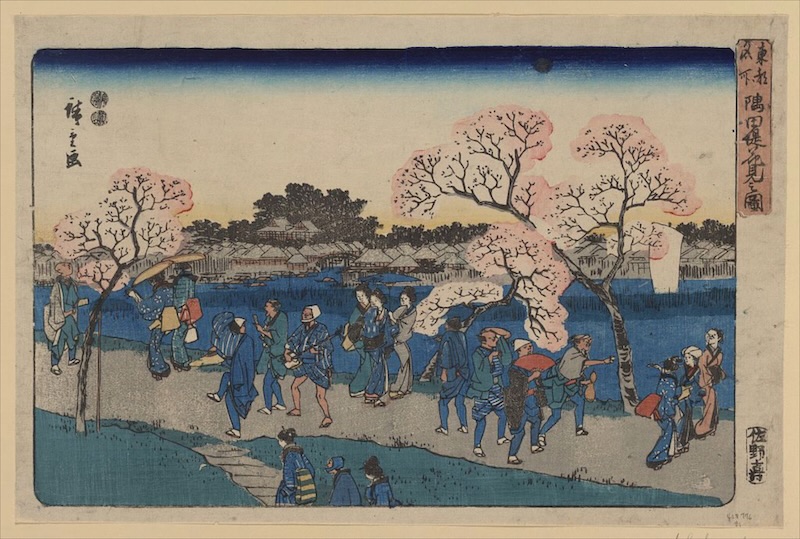
In a previous post, we talked about Hiroshige using this straight, graduated line across the top of his prints.
This technique is called Ichimonji Bokashi, or straight line gradient or sometimes one character gradient. It’s sometimes called one character because a character for one is similar to a straight line in Japanese.
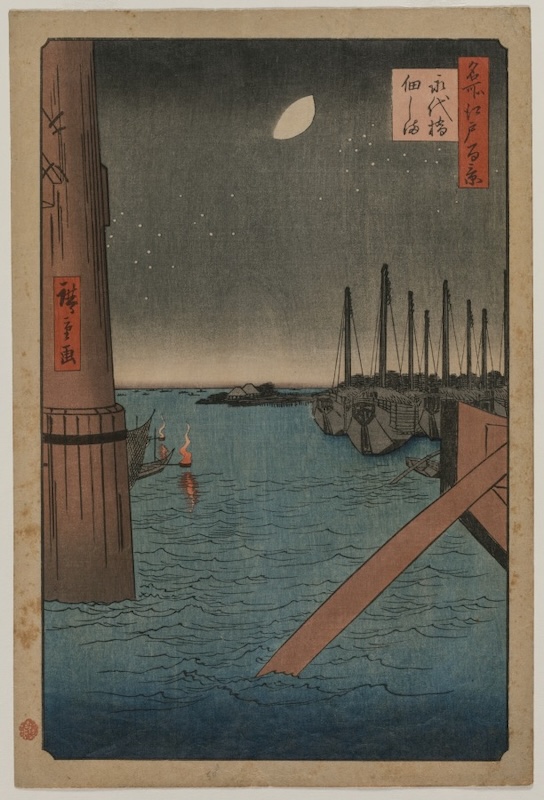
When we looked at this technique previously, we talked about Hiroshige using this on the top of his prints. But the fact is, he didn’t only use it at the top of his prints. Sometimes he used it at the bottom, and we did see that previously.
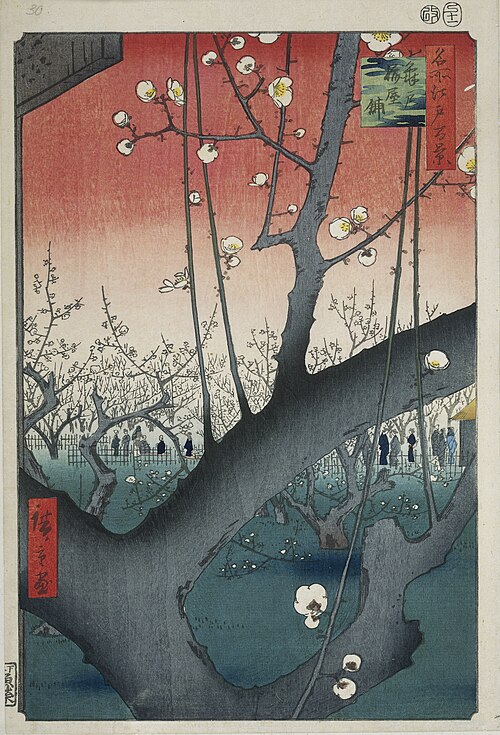
We also see him sometimes using it in the middle, as we see here in this print. And in this print here, where we see the graduated line being used inside the tree to help show the shading in the trunk.
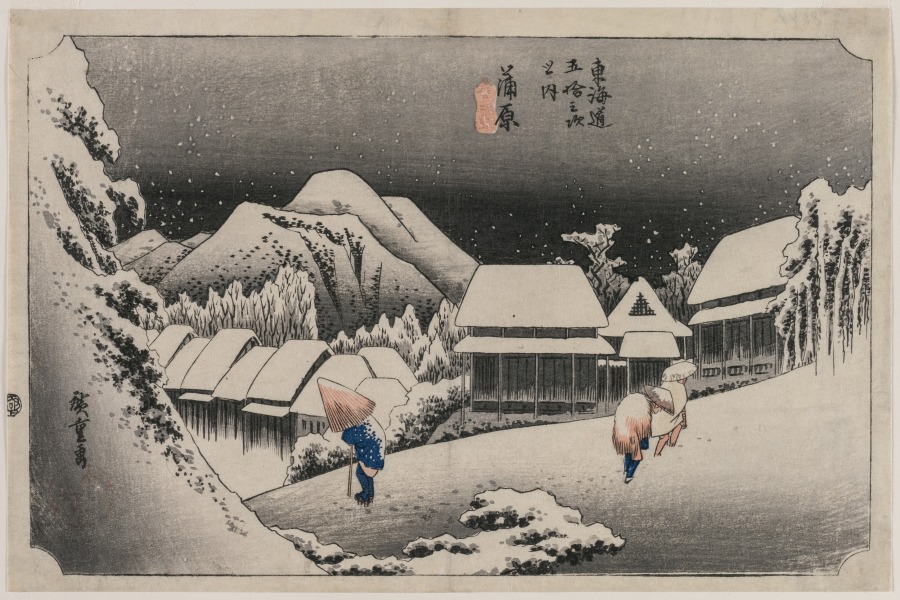
Here is an interesting case, Hiroshige has placed a large graduated line in the center of the work, low down in the sky. This really works to give us a feeling of being inside a snowed-in village, the sky hanging low, the snow thick on the ground, making it hard to go anywhere.
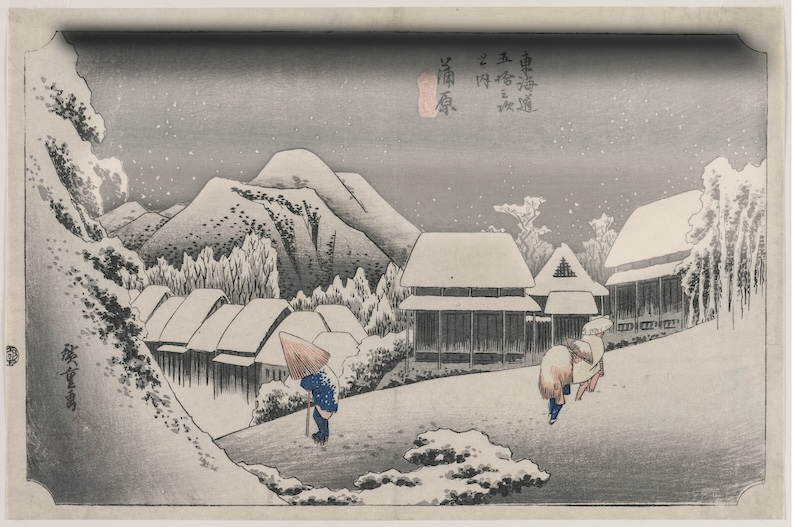
However, if we move the graduated line back up to the top of the print, where we’re now becoming accustomed to seeing it, in this case, the feeling changes immediately. While we still feel the snow and cold through the actions of the figures, at the same time, there’s suddenly more space, and we don’t feel as closed in.
By placing the dark graduated line low down in the sky, Hiroshige has brought our focus down there with it as well, thus making the sky and the whole space feel lower, smaller, more closed in, as we would expect on a bleak, cold winter’s day. This print is a particularly interesting case of Hiroshige using this technique in the center of his piece, because here it’s in the lower part of the sky, the center of the print, but the lower part of the sky. In doing that, he’s bringing the space down. He’s taking our eye and bringing it down, bringing our attention down, and he’s really changing the feel of the piece. This piece is a winter scene. It’s a village snowed in, and he really helps us to feel that by taking that whole space and lowering it as if the snow and the sky has really lowered. And we’re, you know, as we might be in a small village in the middle of the winter and with a lot of heavy snow, we’re kind of trapped there, we’re kind of stuck there, we’re kind of held under the heavy sky, the heavy snow, and there’s a feeling of little room to breathe, little space and nowhere to go. He really captures the essence of that feeling.
Artwork:
Hiroshige, Viewing cherry blossoms along the Sumida River (Sumida tsutsumi hanami no zu)
https://www.loc.gov/item/2009615472/
Utagawa Hiroshige, Tsukudajima from Eitai Bridge, from the series One Hundred Views of Famous Places in Edo, 1858. Courtesy of The Cleveland Museum of Art
https://www.clevelandart.org/print/art/1992.73
Utagawa Hiroshige, Plum Garden at Kameido
https://www.artic.edu/artworks/26577/plum-garden-at-kameido-kameido-umeyashiki-from-the-series-one-hundred-famous-views-of-edo-meisho-edo-hyakkei
Utagawa Hiroshige, Evening Snow at Kambara (number sixteen of the series Fifty-three Stations of the Tokaido), 1833. Courtesy of the Cleveland Museum of Art
https://www.clevelandart.org/art/1985.317