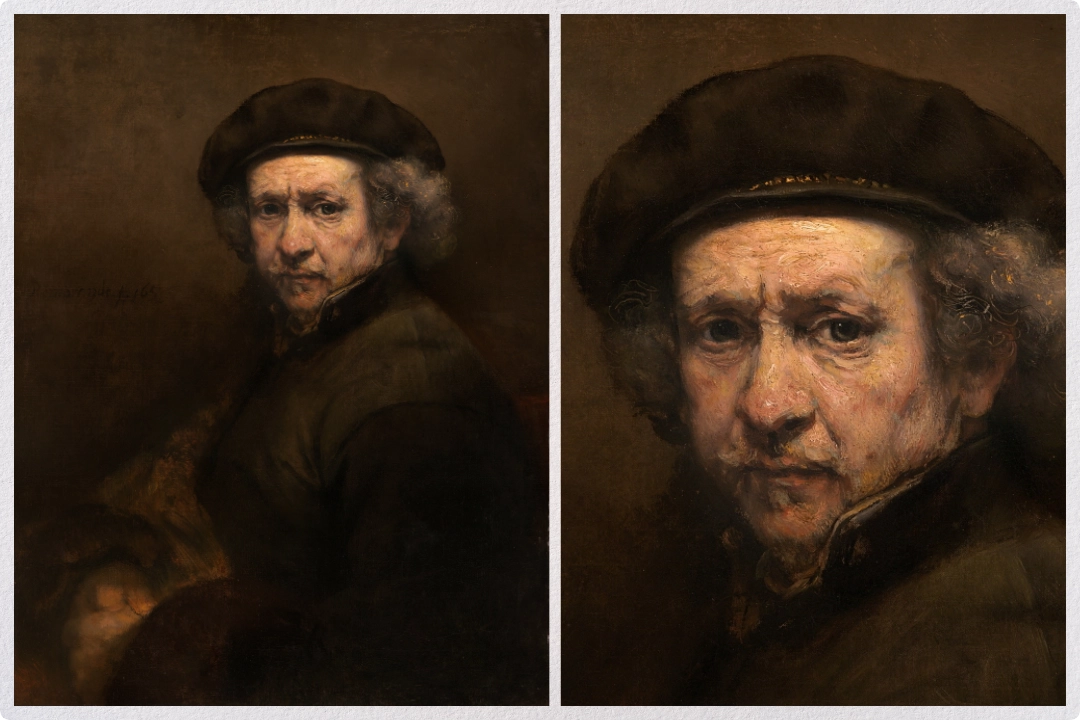
Let’s take a look at this self-portrait by Rembrandt. It was painted in 1659. It’s one of his many self-portraits that he painted. It’s a brilliant painting. We can see how Rembrandt seems to emanate, to emerge from out of the space. He glows, emerging from the background. He does this in a subtle way. His gaze holds us. We feel him as a person.
Importantly, he moves us in and around the space. Rembrandt is a master artist, one of the greatest ever. And there’s a lot we can say about his work, but not right now.
His gaze holds us. We feel him as a person.
For this post, I want to focus on one aspect of his work, and actually, I want to focus on how we can start to learn about one aspect of his work. I want to look at how he uses tonal values.
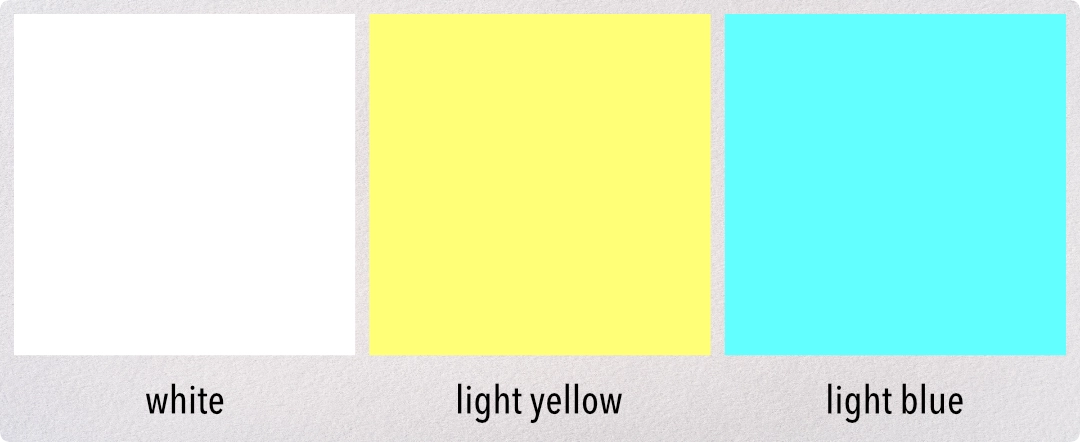
Tonal values describe how dark or light a color is. For example, white would be the lightest tonal value. Light yellow or a very light sky blue would be some lighter tonal values.
Tonal Value: how dark or light a color is.
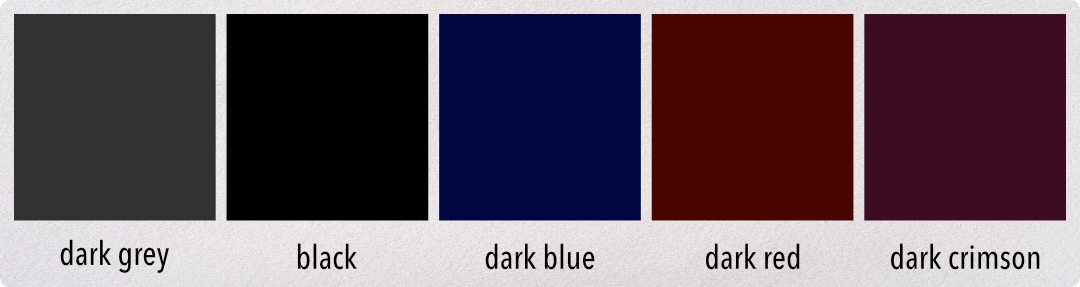
A darker value would be a dark gray, or a black, or a very dark deep blue, a deep red. Dark crimson, would also be a darker value. And then there’s medium values in between. We can see a whole range of light. To medium, to dark values, and everything in between.
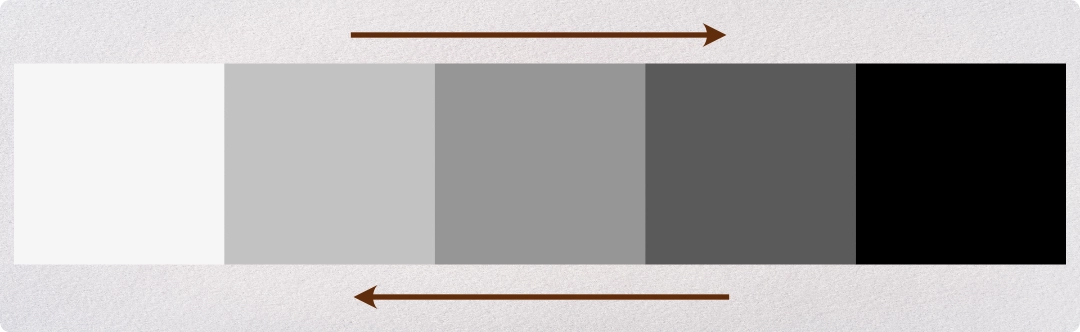
It’s very common as we’re studying art to study tonal values, and we’ll often make charts of three or five or even 10 tonal values and put them in a row. And that’s great. It’s useful. It’s helpful for us to understand the basic concept. But I find that it can be hard to move beyond that sometimes, hard to find how we can use them, and there are different ways we can use them. Similarly, when we’re looking at artwork, sometimes it’s hard to see. There’s so much happening in a painting. It’s hard to see everything that’s going on.
There’s so much happening in a painting. It’s hard to see everything going on.
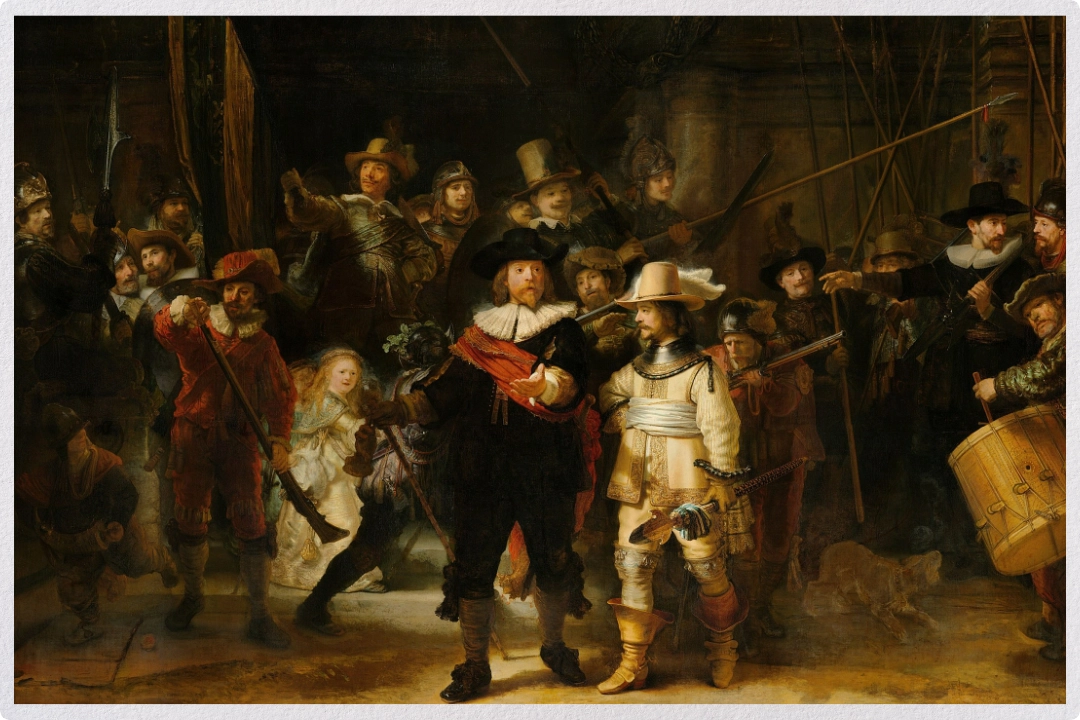
Tonal values are really fundamentally important, especially with an artist like Rembrandt. He moves us around and through the space. One of the ways he does that is through the use of tonal value. He uses shifts and changes in tonal values to make connections throughout the painting.
Rembrandt: shifts and changes in tonal values create connections
Even just saying tonal values is a very large topic in and of itself. And with Rembrandt, there’s a lot to say about it. I don’t want to get into every detail of it. I know I love to do deep dives into artists and artwork and really get down and see what’s happening. But I want to do something a little different in this post. I want to talk about how we can learn about this. Learning how to learn about a topic like this. Learning how to see it a little better, understand it a little better, and conceptualize it a little bit better. This will be useful for us as painters so we can work with it. It’s also very useful for us as we look at artwork and we enjoy artwork so we can start to see not only this one aspect of an artist’s work, but we start to understand how we can see many aspects of artist’s work. So let’s look around in this painting and see if we can notice a few things.
See it, understand it, and conceptualize it a little bit better.
How am I going to do this? What is the starting point? There’s so many places I could start by looking at. The natural place might be the usual points of interest, the hands, the face. While we will look at them, I’m still not sure if that is the right place to focus my attention. One thing I do know however, and we have talked about here a lot, is that edges are important. Edges are important in paintings. Edges are important in many places in life.
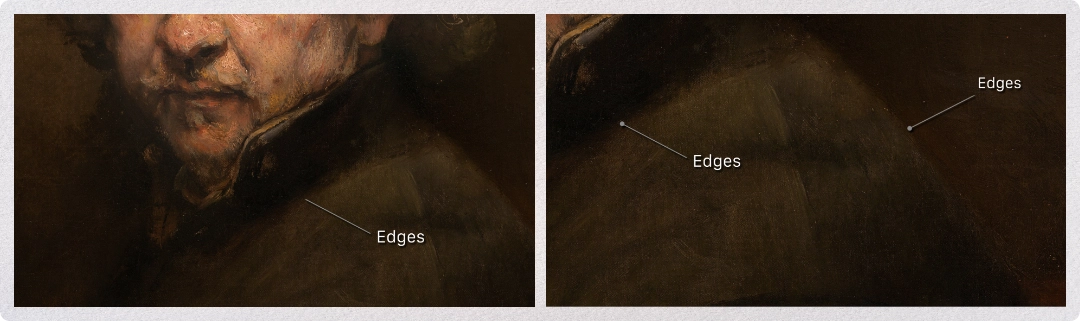
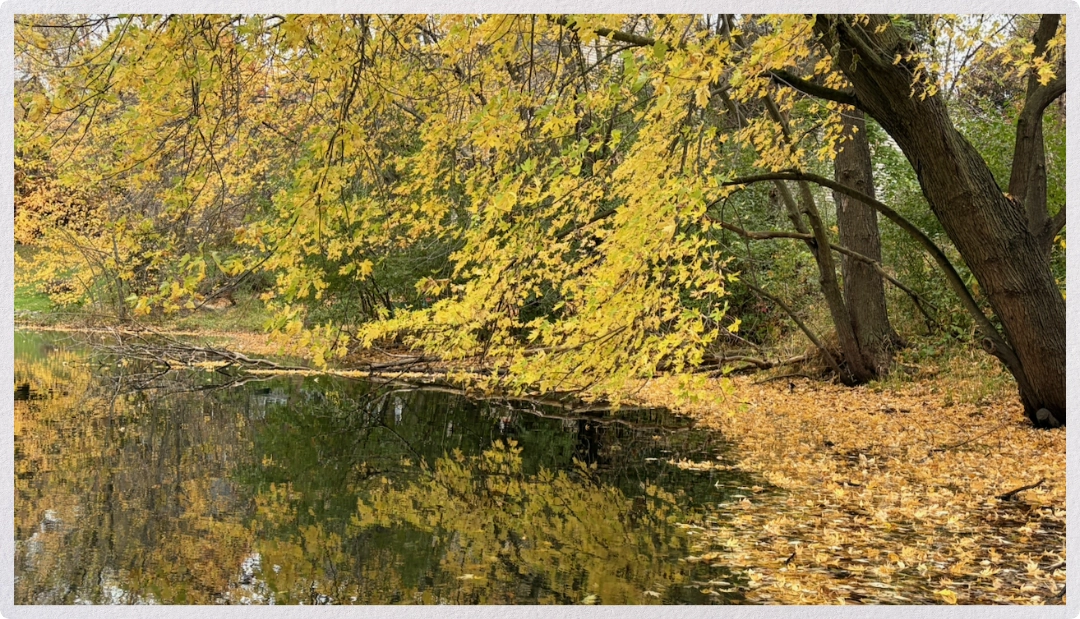
Edges are where things meet. They’re meeting places. Maybe a meeting of two or more people. Or if we look in nature, edges are where two or more ecosystems meet. For example, where a forest comes up to the edge of a lake, we have two ecosystems. The animals, birds, insects, soil and air of the forest, and the life in the lake. Fish, sandy soil, different insects and animals. Some animals might live at the border. Others might live in one or the other, such as fish. And then the lake might attract birds that we would not see in the woods, such as a heron looking for fish.
Edges are meeting places.
Suddenly we have the interaction of these two very different ecosystems, and we can think about, is this interaction sudden and abrupt? Do the trees go right up to the edge of the lake or is it gradual? Is there a space between the two? Perhaps with an intermediary area where there’s a mixture of soils, lower plants that prefer a more moist soil. Such as willow trees.
So edges are places of interest, they’re where things are happening, they’re transitions. Two worlds colliding, and how we handle that says a lot. In the case of a painting such as this one by Rembrandt, it determines a lot of the feeling that the work will create.
Rembrandt and Frans Hals, Contemporaries
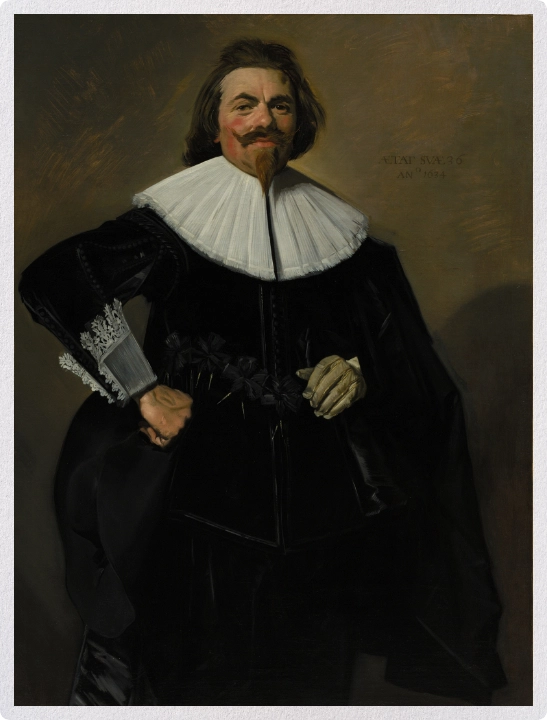
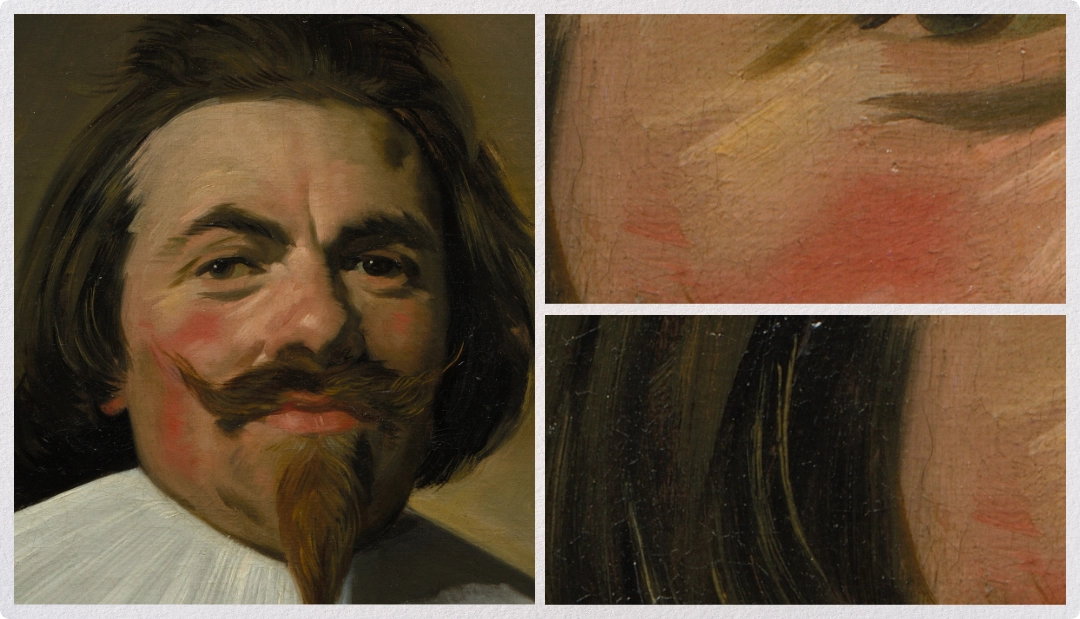
Let’s look briefly at this painting by Frans Hals as a source of comparison. Frans Hals is a good comparison for Rembrandt, as they were contemporaries, and sometimes we will hear the two being compared. This painting by Frans Hals is a portrait of Tielemann Roosterman from 1634. Roosterman, who was 36 years old when this was painted, was an extremely wealthy linen and silk merchant in Haarlem. We can see that Hals favored strong, visible brushstrokes, which is very different than many of the other Dutch painters of the time.
If we look at the face in the portrait, not only do we see the strong, visible brushstrokes, but we also see a strong value contrast. The face being quite light and the hair quite dark, for example. But the change is also very abrupt. Here we have a light color, and then suddenly, right away, here is a dark color. In many places, there is very little, if any, transition between the two. It is brilliant in the way he was able to lay down brushstrokes so cleanly and leave them. It’s quite bold.
Let’s go back to the painting by Rembrandt. It’s similar in ways to the Hals in that, well, it is a portrait. In this case, a self-portrait. Rembrandt did many self-portraits.
Hals: stark transition
Rembrandt: Gradual transition, subtle and complex
As with the Hals, let’s start by going to the face and looking there. Let’s go to the same edge of the face and the hair. Here we can see a clear difference in how it’s painted. As opposed to this stark transition of the Hals painting, Rembrandt offers us a more gradual transition. It’s more subtle and more complex. And the value transitions are more tempered. Rather than bold, simple brushstrokes, Rembrandt works the surface. Creating more complex transitions. Even when he’s creating more textured surfaces, Rembrandt is still able to make complex and subtle transitions.
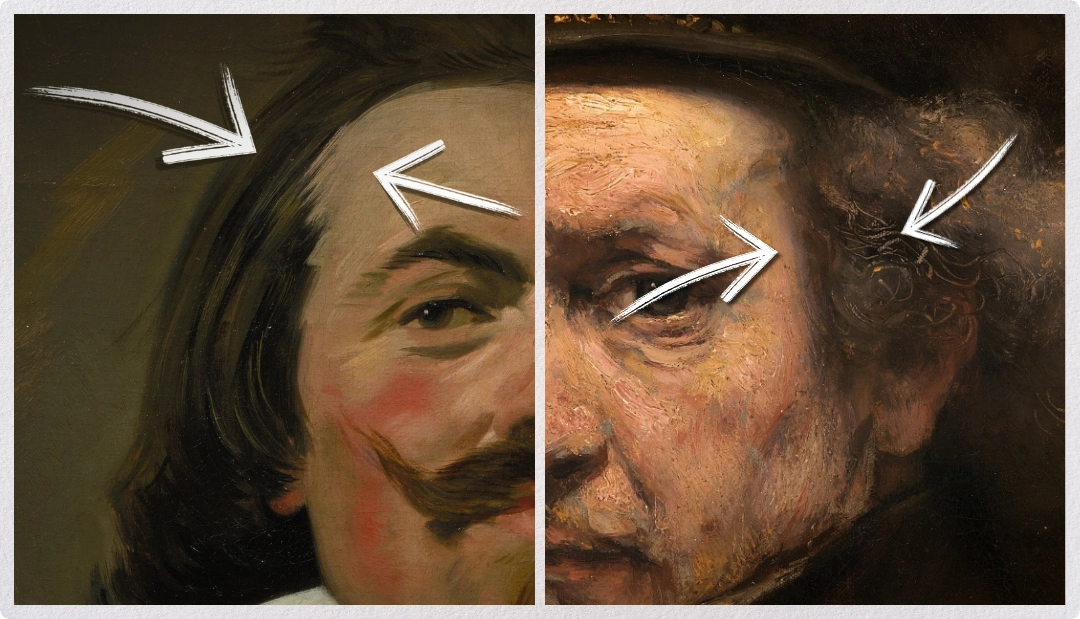
Let’s focus on those value transitions. This is a fascinating aspect of Rembrandt’s technique and he’s a master of it. And value transitions are important in general for all artists. Whether we want to have more subtle, complex transitions as we see with Rembrandt, or bolder, starker ones as we see with Hals, either way, as an artist, it’s very important for us to study this idea of value transitions, and looking at Rembrandt is a wonderful opportunity to do that.
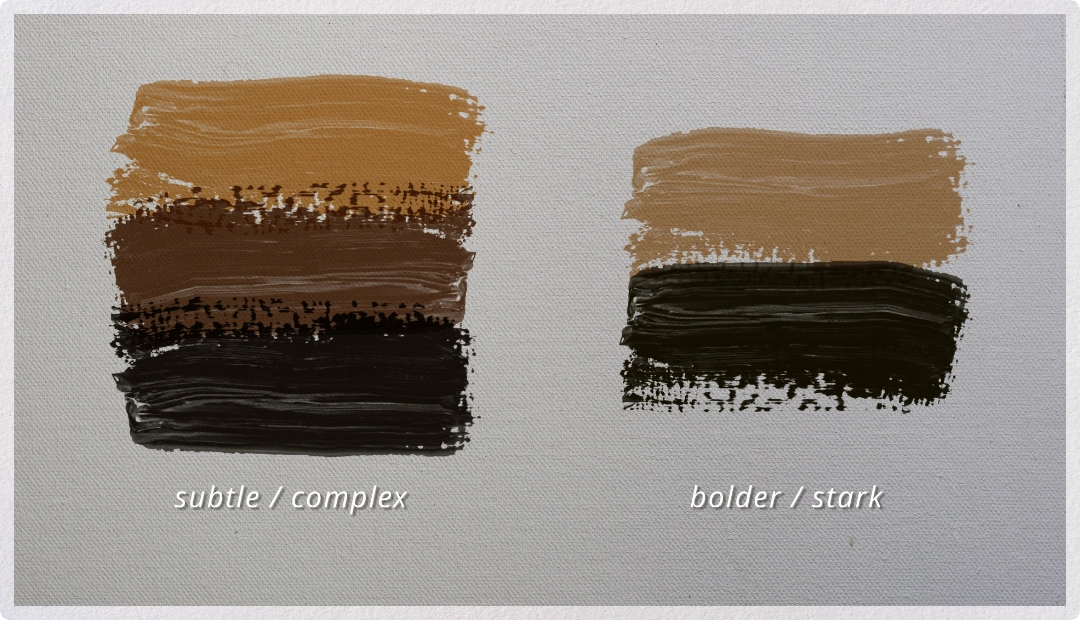
There are a lot of aspects that we could study here. Certainly, we could study his brushwork and how he creates his complex surfaces and his subtle transitions. But I want to keep things a bit simpler for now. I want to look at the value transitions themselves. I want to understand what value changes he’s using to create these transitions. This seems to be the most basic element that I can study here. After that, I can go about trying to understand other parts of this work. I want to look at the value transitions themselves. That is, in a much simpler way, how does he go from a dark to a light?
We saw with Franz Hals that it can sometimes be a very drastic, in that we have a dark and a light right next to each other. But if we look at Rembrandt, we’ll see that so many of his value transitions are tempered. What I mean by that is, if we look at the hair and then move our attention into the face, there’s an area in between where he transitions us more subtly. So the dark moves into a medium value, which moves into a light, or taken the other way, the light of the face, and then a more medium value, perhaps with some shadow from the hair or shadow from the turning of the face, and then we get into the dark area of the hair. There is a transitional area, and as opposed to two values next to each other, we see three. We see the light, we see the dark, and we see the medium value in between. This is already something very interesting to think about.
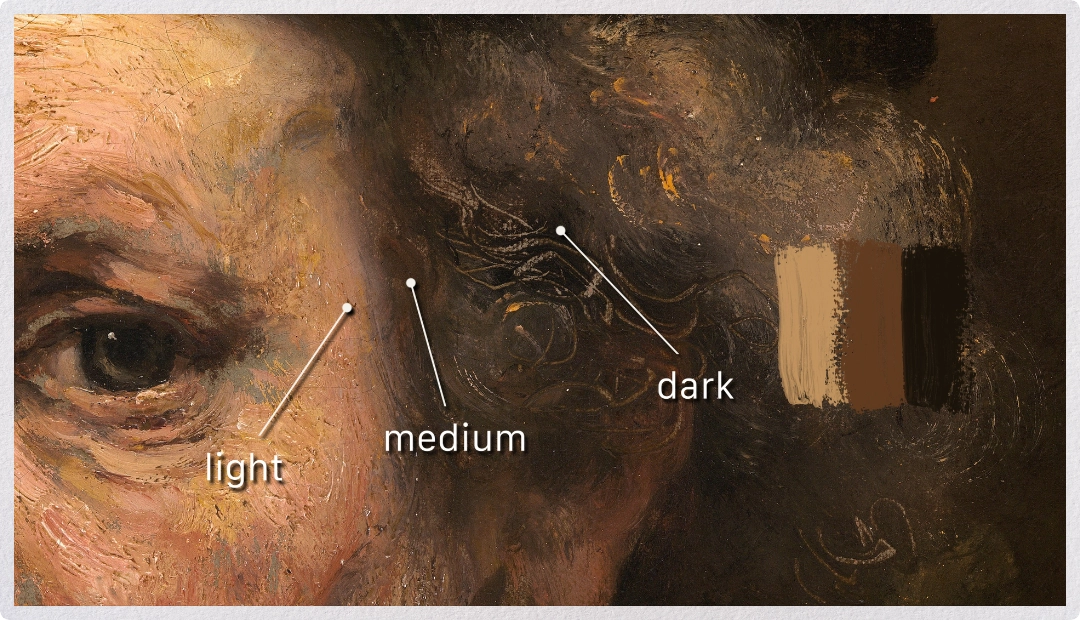
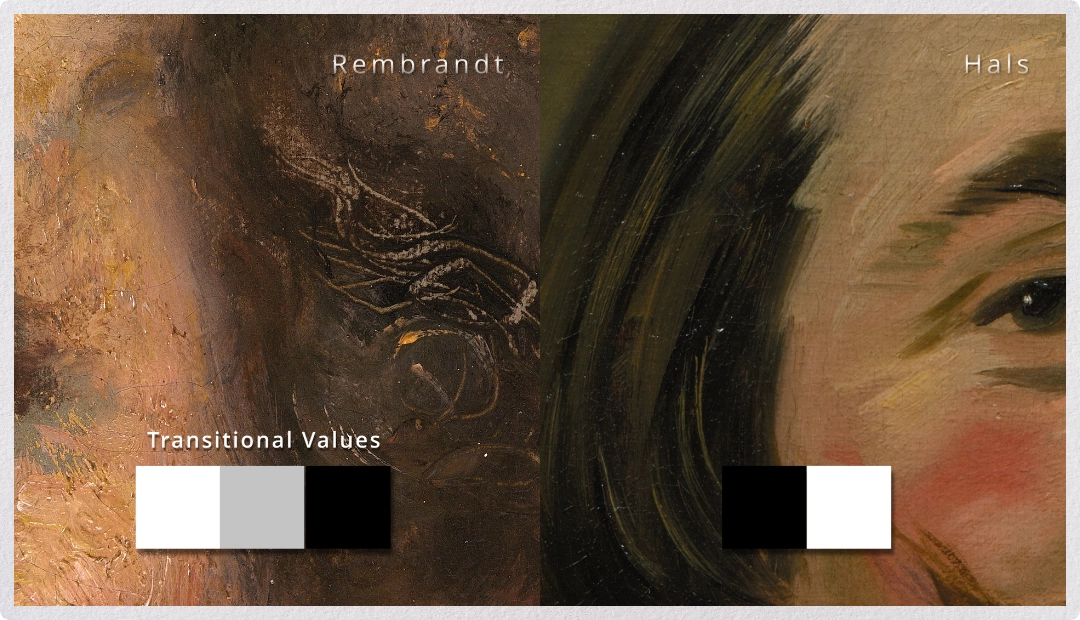
With Hals, although there certainly is a lot of subtlety there, but if we want to simplify it, again, we want to start to find a way to understand a little bit of what’s happening, so we need to simplify some things. We need to make some observations and simplify them into a usable and understandable model. We don’t want to lose too much information, but we want to be able to understand it and make some general observations about it. One observation we could make is, with Hals, we might have a direct contrast of two values, a light and a dark, but with Rembrandt, there’s a tempering. There’s a space in between. There’s a transitional space from one value to another.
Hals: two values
Rembrandt: three values, tempering
Thus, whereas Hals might be value pairs contrasted next to each other, with Rembrandt, it is more akin to three values, because we have that medium, in-between transitional area as well. That is very interesting, and raises questions as well. Let’s think about this as we look through. Do we find more places where it is three value areas working together to create a space; to create a movement and a transition.
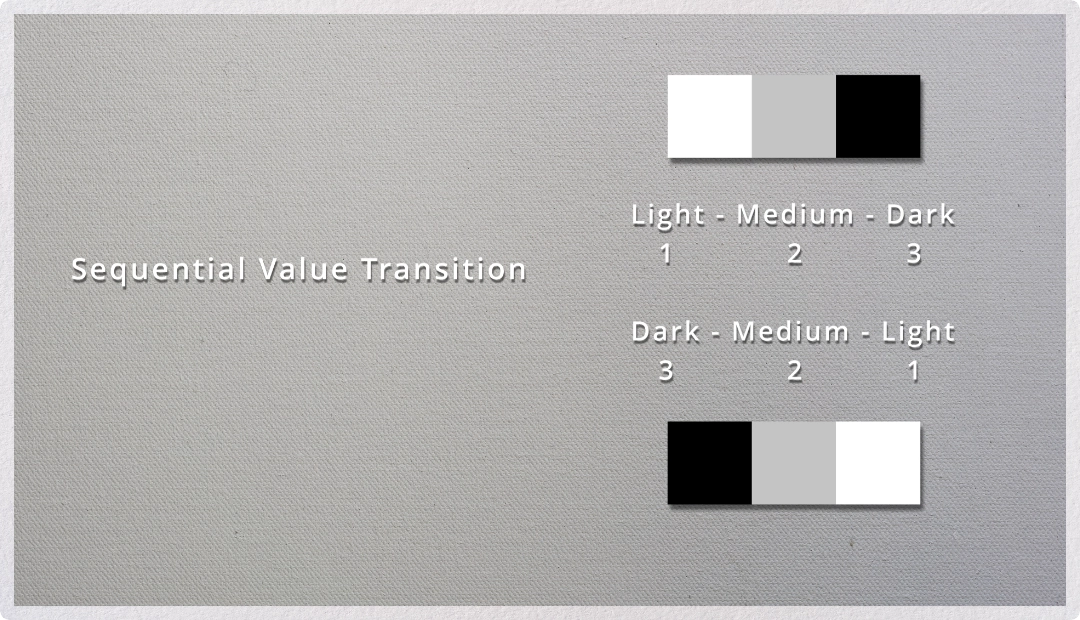
Sequential Value Transition
Let’s look at this one area in detail right from the face to the hair. Rembrandt takes us from a light area to an area of medium value, and then to a darker value. This is much as we would expect. Value transitions going in order, from light to medium to dark. In other places where he might go from dark to medium to light. Either way, it’s a sequential value transition, light, medium, dark, dark, medium, light. Even if it’s not fully dark or fully light, even if it’s not a very strong change, this idea of going in order, one, two, three, three, two, one, this sequential value transition is I think pretty much what we would expect, quite a normal way to go about value transitions and a nice place to start.
Sequential Value Transition: value transition in order
light – medium – dark
dark – medium light
For now, I’m not trying to look in depth at exactly how he accomplishes this. We can see a lot of beautiful and really subtle, amazing brushwork and the way he uses a paint. But again, for now, let’s just understand the fact that this is one idea of a value transition. We have, we’ll call it a sequential value transition. Light, medium, dark, dark, medium, light. One, two, three, three, two, one. A very nice, simple, and clear idea.
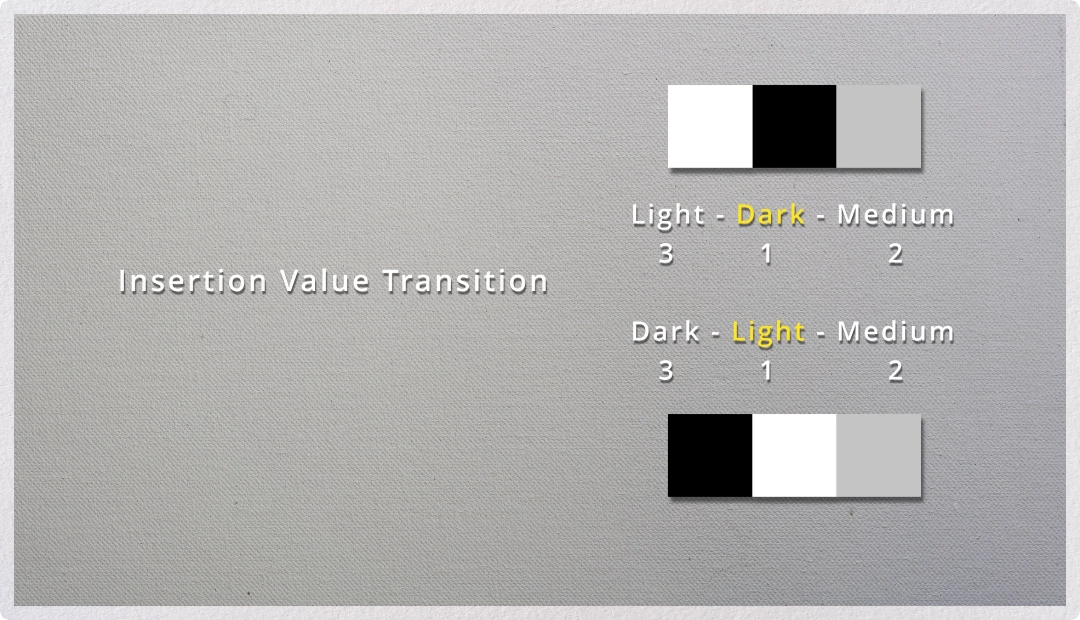
Insertion Value Transition
We’ll see very quickly that it’s not the only kind of value transition he created. If we look towards the top of the painting, we can see that Rembrandt is creating a bit of light right above the hat. There’s a glow there. This is a technique that Rembrandt used to create movement in the work. We’ll talk about this technique and this idea of movement in a separate post. It’s very important. It’s something that Rembrandt did a lot of. And it’s very important in the sense of how he creates movement. And it’s something that we’re going to study further. But again, this is a first step in understanding it. So first, we need to be able to see what he’s doing and be able to do a little bit of it ourselves. Later, we can go about seeing how it affects the whole of the pictorial space. For now, let’s focus on what he’s doing in terms of values. What he’s doing in terms of values and how that’s allowing him to create this effect.
Insertion Value Transition: glow and movement
dark – light – medium
If we look at this from a distance or a simple point of view, it can look like a dark and a medium value. However, if we look closer, we can see that in between this dark and medium value, there’s a lighter value. It’s subtle, so it can be hard to see. In some ways, it’s easiest to feel it, as we did at first, as a general sense of lightness, a glow around the head. But we want to look very closely so we can get a clearer idea of what Rembrandt is doing. This area of lighter value is not a shocking difference, not a huge contrast from the medium value. It’s integrated into the medium value area. It’s a smaller area, in a sense, within that larger area. Thus, it’s meant to be a subtle lifting of light, not a harsh or shocking contrast. It’s a subtlety which gives that glowing effect rather than having a strong contrast, which would stand out and maybe be more like steps or, be a very discrete area, a discrete (distinct) contrast. This creates a subtle glow and a movement that, even if we can’t point to it at first, we feel it. We can see here, then, a different ordering. We go from dark to light to medium. So we skip one level, and then we come back to it, in a sense. Instead of 1-2-3, 3-2-1 of light-medium-dark, dark-medium-light, now we’ve gone dark-light-medium, or perhaps it’s better said we insert a lighter value in between the two values. So we can see a different ordering from the top of the hat to the background.
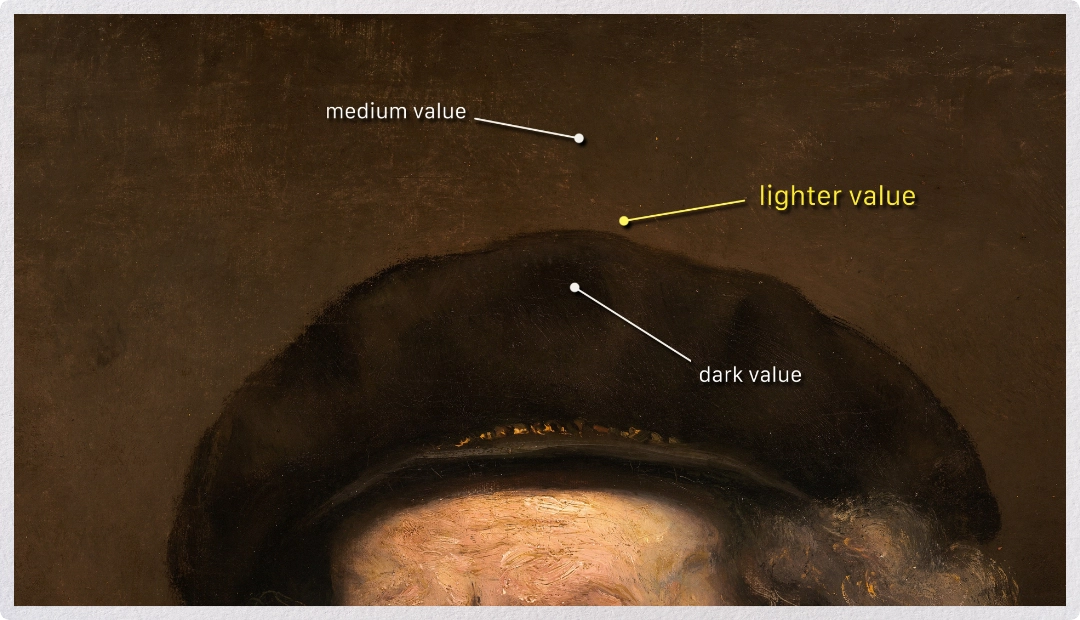
In this case, Rembrandt uses this to create movement in his work. He creates movement in the whole work. We can talk about this as inserting a lighter value in between the two values. Of course, we could also do this in reverse. We could go from light to medium with a dark insertion. Either way, let’s call this an insertion value transition. We see this exact pattern at the bottom of his face and the interaction with the collar.
Lost Edge Hesitation
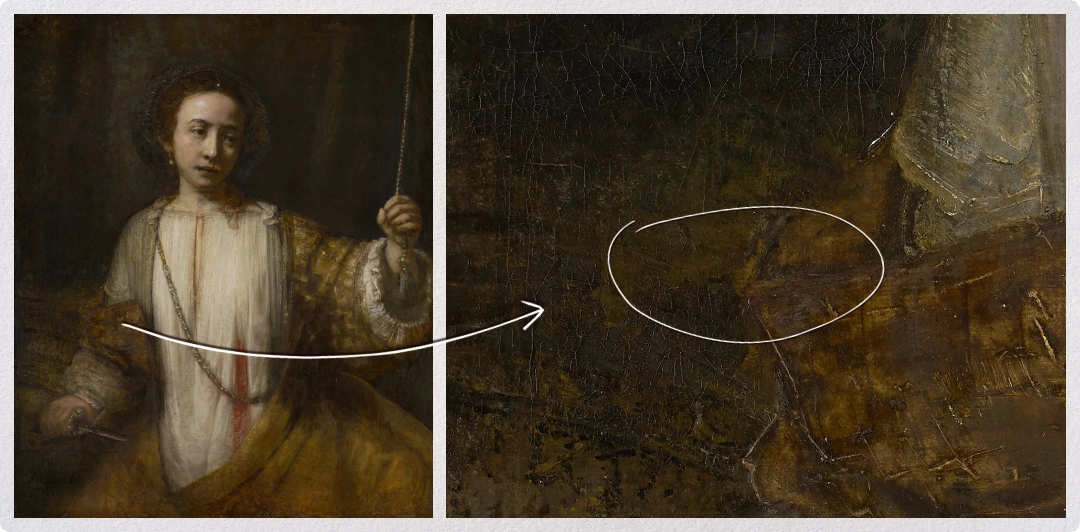
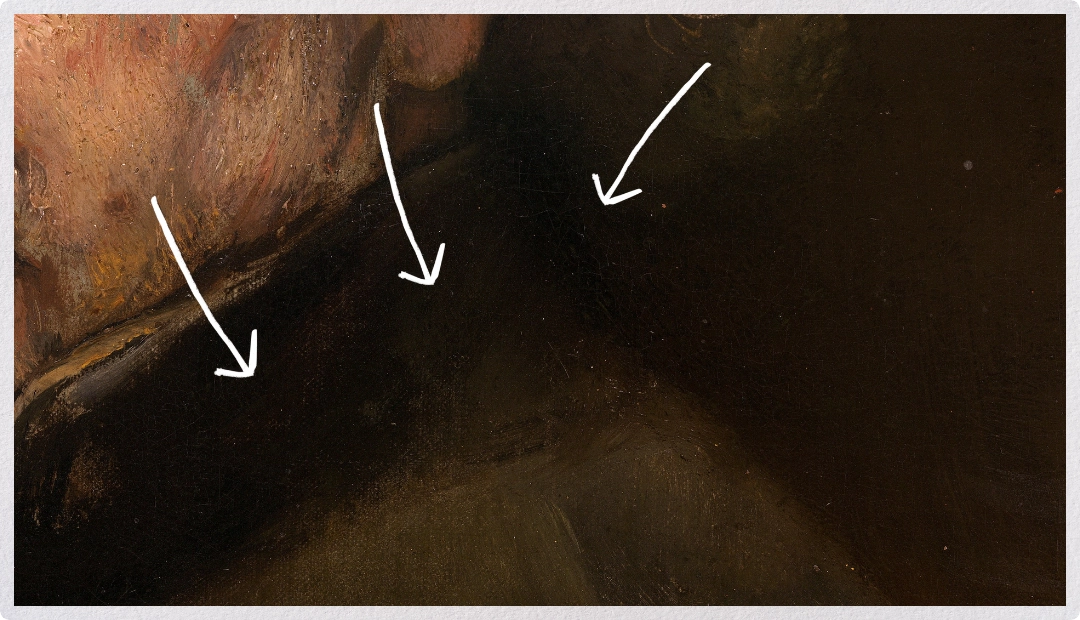
Among the many things that Rembrandt does masterfully is allow shapes and spaces from the foreground to dissolve into the background, losing the edges, often dark values dissolving into dark values, but not always dark values. I’ve also seen him do this with more medium values as well. This movement goes two ways. Not only can aspects of the figure dissolve into the background, we can also feel them emerging out of the darkness or out of the background space. What he’s actually doing is not exactly a transition as we see with the sequential transition, for example. It’s more of a hesitation. We’re moving into darkness, but there’s a brief pause.
Lost Edge Hesitation: Moving into darkness, Pausing
If we look at the more medium value that we see here in the painting Lucretia, we can see that Rembrandt uses a lighter or a darker value to achieve this result. It has the effect of differentiating the two areas. So they remain distinct entities, yet he still achieves that effect of lost edges that he’s looking for. The subtlety there is that he’s achieving two things at once. He’s defining two areas, but he’s still keeping the effect of lost edges. He’s also allowing two areas to dissolve into each other. He’s allowing the foreground to dissolve into the background. Or, looked at from the other point of view, he’s allowing the foreground to emerge out of the background space.
We’ve looked at Rembrandt’s work, we’ve identified some aspects of how he works, and hopefully we’ve not only learned to see his work a little better, but in general, we’re learning to see a little better. When we want to look at any other work, now we have a little more experience and a little more inkling of how might we start, how we might go about it. Now we can think a little better about artwork and think about how an artist goes about organizing their work. We can also consider, is that something we want for our own work? Or if I’m going to the museum and I’m looking at artwork, I can consider if that the kind of work that I enjoy. Do I enjoy that subtlety of those transitions that Rembrandt employs? Or maybe I prefer what Frans Hals does with those strong transitions. Or maybe, which is quite possible. I really enjoy them both. And now that I can understand them more clearly, I can enjoy them even more deeply.
I hope this was enjoyable for you. I’ve really found it very interesting. I think we learned a lot about Rembrandt. While I was aware of some aspects of Rembrandt’s use of light, I did not have such a clear understanding of these three value transition techniques before beginning this research. This was very helpful and interesting for me, and I hope that you found it as such as well.