What do you think of when you think of a painting?
There’s so many different ways to approach this topic that sometimes it’s hard to know where to start.
We’re going to focus on the idea of a tree. There’s so many different ways to approach the painting of a tree that really can go in many different directions.
We’re going to look at seven paintings of trees that span 350 years. So we are going see quite a bit of diversity. We’re going to see paintings that are very classical in nature with a lot of focus on detail, focus on light, subtle colors. We’re also going to see stronger colors and bolder movements. And we’re going to take some time to think about what we like in paintings and how we might want to approach them in our own paintings.
Painting 1: Claude Lorrain, An Artist Studying from Nature, 1639
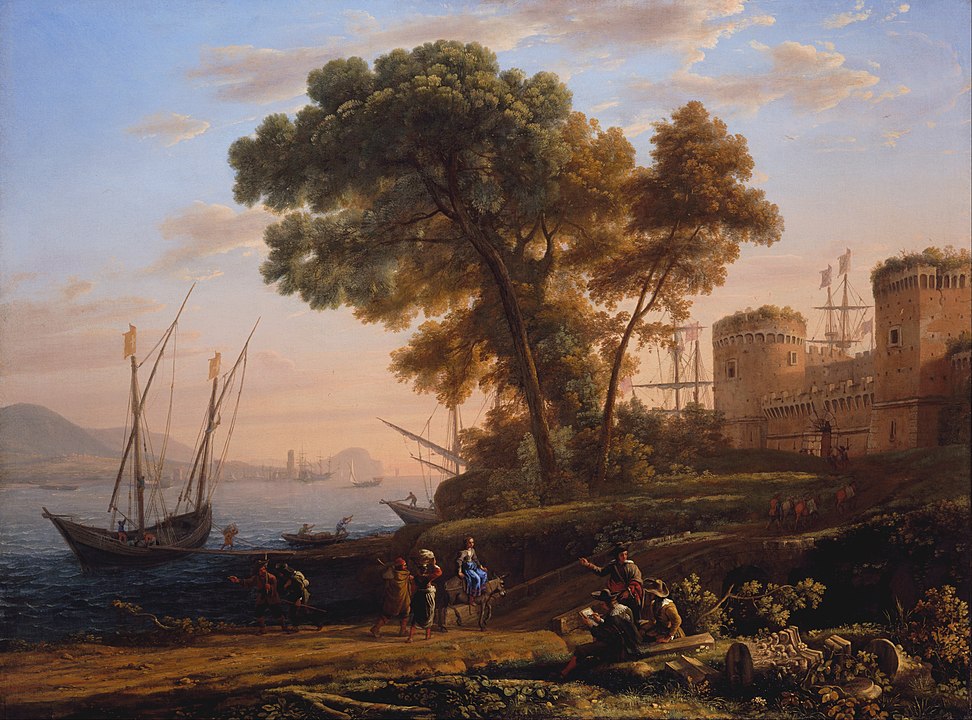
An Artist Studying from Nature
1639
The first painting we’re going to look at is called “An Artist Studying from Nature” by Claude Lorrain, from 1639. We can see it’s very classical in nature. Lorrain, in fact, was one of the early pioneers of landscape painting. We can see in the painting, there’s a great sense of harmony and light and maybe that classical serenity that we might think of. Lorrain developed his style through the close observation of nature and light and by sketching outdoors. And we can see that in this work. We can see how he shows light and atmosphere.
There’s a great sense of unity and there’s a great amount of detail. We can even see individual leaves. And not just leaves, we can see indications of bark and the tree trunk, but he’s not just painting the tree trunk. These are very soft indications. It’s very beautifully done. A lot of tenderness, a lot of gentleness there. There is a great softness and a melding together of the details. It’s not just detail after detail after detail. It’s not a painting that shouts, look at my technical prowess. Even though technically he was amazing, he has great prowess in terms of his technical ability, but he’s not shouting that. He’s making something that is very harmonious. The details work together to the whole and there’s a great beauty to it.
Even with this amazing technical execution, the painting is somewhat restrained and it can be easy for us to pass over it as we look at it in the museum or wherever we might have the opportunity to see such a painting. There’s not as many colors as in some of the more modern paintings. It’s not as strongly painted. But if we go in and we look at some of these details and we look closer at the painting, it’s not a question of just, oh, I painted individual leaves. It’s how they’re painted. It’s the feeling, the sensitivity of how the light is falling on the leaves. It’s how they’re taking us on a journey through the whole canopy formed by these group of trees together. And there’s a real beauty there. It is perhaps quieter than contemporary paintings. But if we take the time to look through it, we can see that he really takes us on a beautiful journey.
Painting 2: Jean-Baptiste Camille Corot, The Moored Boatman: Souvenir of an Italian Lake, 1860

The Moored Boatman: Souvenir of an Italian Lake
1860
The second painting we’re going to look at is called The Moored Boatman: Souvenir of an Italian Lake, by Jean-Baptiste Camille Corot, from 1860. This is a big jump. We’re now over 200 years later than the first painting we looked at. However, as we look at this painting, it still maintains a very classical look. When I was first thinking about what paintings to consider, I thought that perhaps this painting was too close to the Claude Lorrain one. It thought that It was very similar in it’s classical appearance, and I considered using something different. However, as I started to look at it more, I started to realize that this is incredibly different. Claude Lorrain’s painting is very detailed. We see individual leaves. And it is very slow painting, it took a lot of time. It’s quite likely painted in the classical style of painting where you do a tonal painting underneath and then you glaze on top of it.
This painting by Corot is very different. If we look closer at the tree and the leaves, to start with, we don’t really see individual leaves anymore. We do see indications of individual leaves, but it’s really movement of the brush. It’s a very facile, a very fast, a very quick, a very smooth and loose way of painting. The way he uses the brush and the paint is very different. It’s much looser, much quicker, much freer. We might start by looking at this tree in front and saying, well, he’s painting the bark and the details and the indications of it. And he is, but he’s doing so already in a fairly loose way. But immediately, as we go back to the tree behind that, we can see that tree trunk and the different branches painted very loosely. There’s a lot of suggestion of the branch.
When we look at this painting at first, it might feel very similar to the first one, very classical, very restrained, a lot of detail. But as we take a bit more time to look at it, it’s quite different. It’s much freer. There is much more movement. It is much bolder of a painting. There’s more of a feeling of a livelier canvas, an active canvas, the paint and the brush are more active and more overlapping. Things are happening all at once, as opposed to what we saw previously, where it felt like things happened carefully in their time with clarity and precision. So between these two paintings, even though they both feel very classical in nature, they’re very, very different in how they’re handling paint.
Painting 3: Claude Monet, The Bodmer Oak, Fontainebleau Forest, 1865
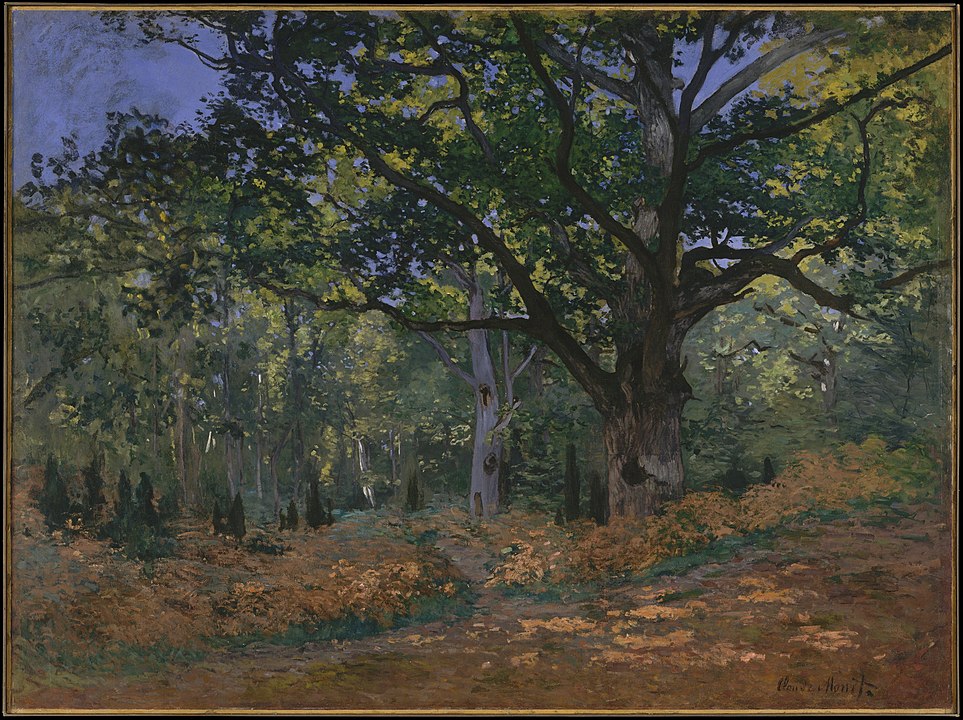
The Bodmer Oak, Fontainebleau Forest
1865
The third painting we’re going to look at is by Claude Monet. The name of it is “The Bodmer Oak, Fontainebleau Forest.” This painting is from 1865. So only four years later than the painting we just saw by Corot. But again, we see something very different. For starters, there’s much more color in this painting. You may have noticed that I didn’t choose one of Monet’s later paintings, which are really representative of the impressionist style. This is an earlier painting and an earlier style from Monet. I chose this painting because I think this is closer to what we see from a lot of artists today. It’s a style that’s kind of early impressionist, not fully impressionist, but still colorful and focused on larger shapes rather than individual, little details. So I thought that this would be a really nice painting for us to look at. This is much more colorful than the other two paintings we saw. There’s larger planes, larger areas of color. The colors are stronger and more saturated.
Painting 4: Vincent van Gogh, The Large Plane Trees, 1889
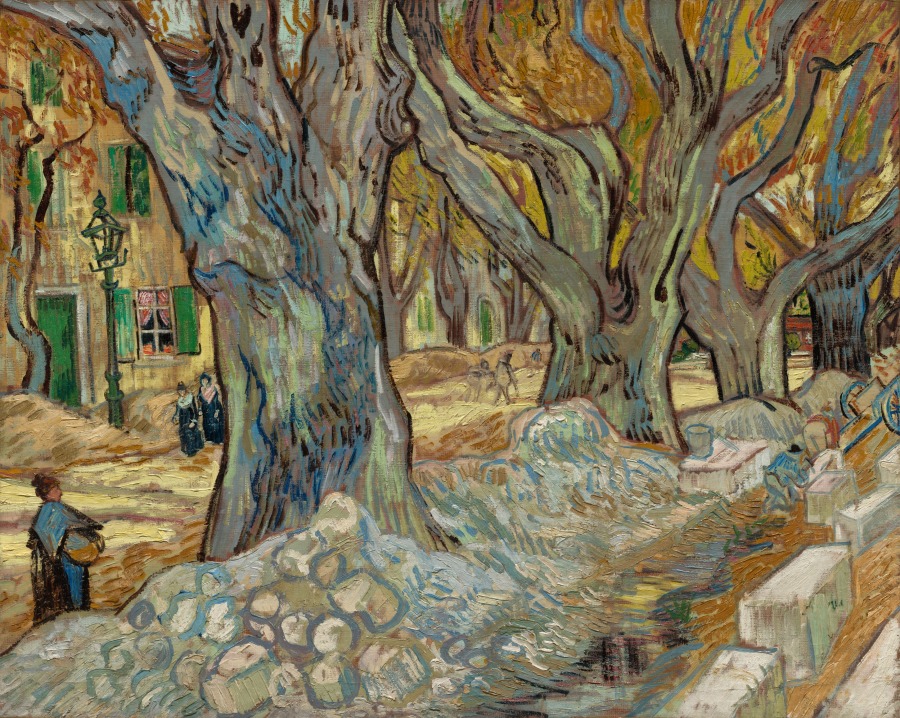
The Large Plane Trees
1889
The fourth painting we’re going to look at is called “The Large Plane Trees” by Vincent van Gogh, from 1889, just a little bit later than the other two paintings we just saw. This painting is very colorful. The colors are very strong and in fact, in many ways, the colors take center stage. If we look at the details on the trees and notice the leaves and the canopy of the trees, all these details seem more like an opportunity to show the color and to highlight color and see how color is playing on the trees or in the leaves. He’s not painting leaves. He’s painting areas of color, movements of color, and he’s using bits of line to highlight that.
We can see where he suddenly goes from a greenish area on the tree to a blue area. We also see a number of blue branches, as well as highlights of blue in the trunks playing next to green areas in the same trunks. This isn’t how the trees actually look. This is van Gogh playing with color, showing us color. This symphony of color and their movements and their interactions. The trees are almost a foil for that. This is an opportunity to allow him to play with these colors. And we can see how he’s taking a lot of liberty with shape because he’s really giving center stage to the color.
Painting 5: Edouard Vuillard, Under the Trees, 1894
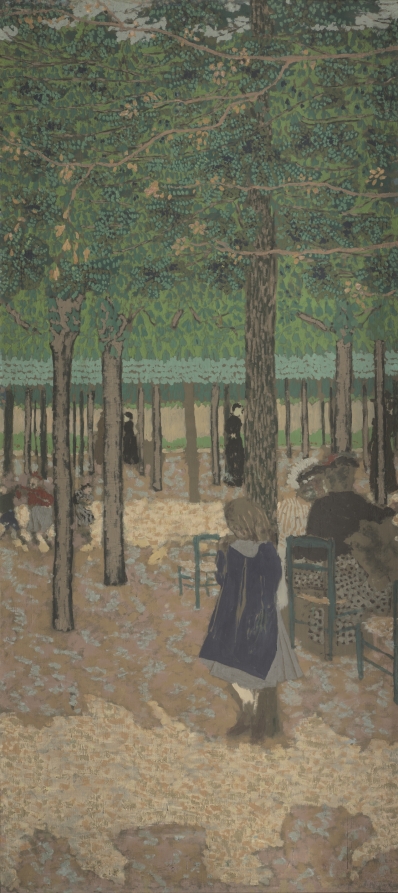
Under the Trees
1894
The fifth painting is by Edouard Vuillard. It’s called “Under the Trees” and it’s from 1894. This painting shows a very different way of handling everything really: color, leaves, and trees. It’s a very different approach to a tree in general. It feels less about individual trees, and more about a pattern, the pattern of trees. Certainly there are some aspects of individual trees. We see branches and leaves, but it feels almost like tree branches passing through a pattern, as opposed to a painting about the individual tree and the individual branches. I don’t mean a pattern as in an exactly reproducing pattern, but a sense of a feeling that these aren’t individual, actual leaves where we think of a leaf that I saw here, and a leaf that I saw there, and a branch that went that way, and another branch that went the other way. It doesn’t feel that individualized. It feels more abstracted. Not abstract in the sense that we think of abstract painting, but abstracted in the sense of the idea of trees, the idea of leaves, the idea of a park, of a forest of trees, abstracting the concept in that way. Painting something that talks more about that larger concept and less about these particular individual trees. Trees that we see across time, people passing under trees, walking among the trees, talking and playing among the trees across time, not just these particular trees in this particular park.
Painting 6: Piet Mondrian, The Gray Tree, 1911
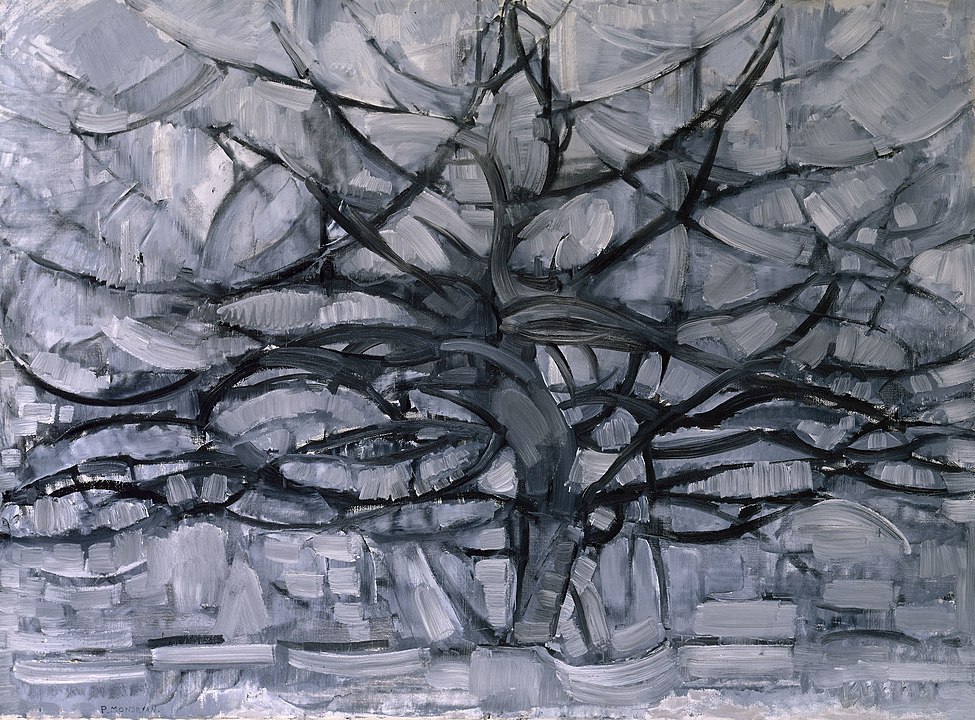
The Gray Tree
1911
The sixth tree in this series is by Piet Mondrian. It’s called, “The Gray Tree,” and it’s from 1911. This tree is very different than anything we’ve seen so far. It’s a very different conception of a tree. It’s a very different approach to painting a tree, with a very different focus. This tree, the painting, is more about the space, the space in between the tree, the space that’s being defined by the tree and the space that’s defining the tree. The interaction of space in the tree and outside of the tree. While we can see a lot of linear movements and spaces that feel like rectangles and boxes and planes, there’s also some wonderful, beautiful, graceful movements. Very organic, smooth and flowing movements. So the painting actually has quite a nice interaction of these smoother graceful spaces and the more rectilinear areas.
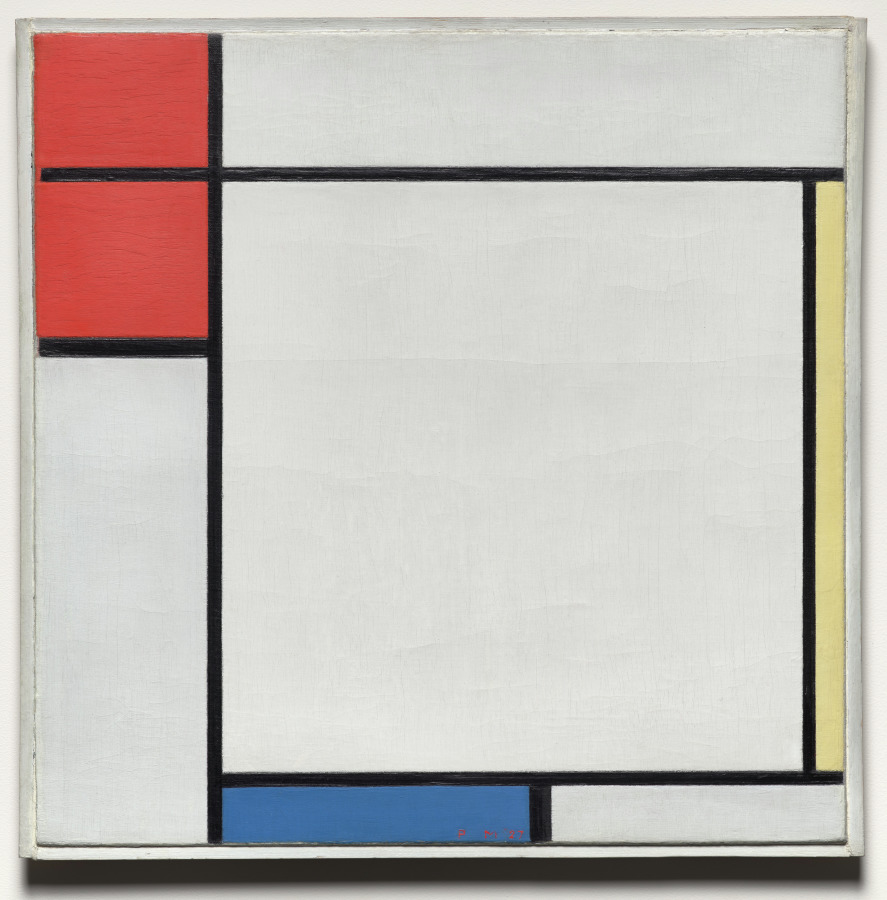
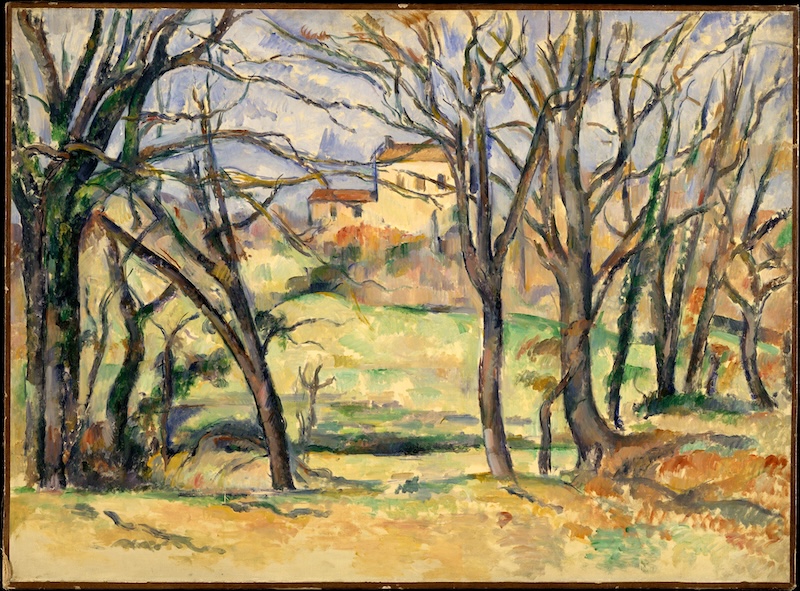
Some people will talk about this painting in reference to cubism, and I do think there is some relationship certainly to cubism, but I think it actually goes more to the place where cubism grew from, which is Cézanne. It speaks to Cézanne’s interest in space and planes and how objects and pieces were created through those planes and those spaces. We can see that where Mondrian eventually takes this kind of thinking is not to cubism, but to this very different idea, this very unique way of working that he created. So this is a very unique, very different way to think about space, and to think about painting.
Thus, Mondrian can help us understand how Cézanne was thinking about space as well. I can understand a bit about Mondrian, but I can understand more about Cézanne. I can start to consider how I want to think about space in my painting. How is the tree affecting space? How is the space affecting the tree? And even if I don’t want to paint it in this kind of a style, it helps me to think about that. This painting helps us to understand how other artists are thinking about space as well. Mondrian can give us some clues to how artists are thinking about space, and how we might want to think about space in our own work.
Painting 7: Wu Guangzhong (吳冠中), Qiu Song (虯松), 1989
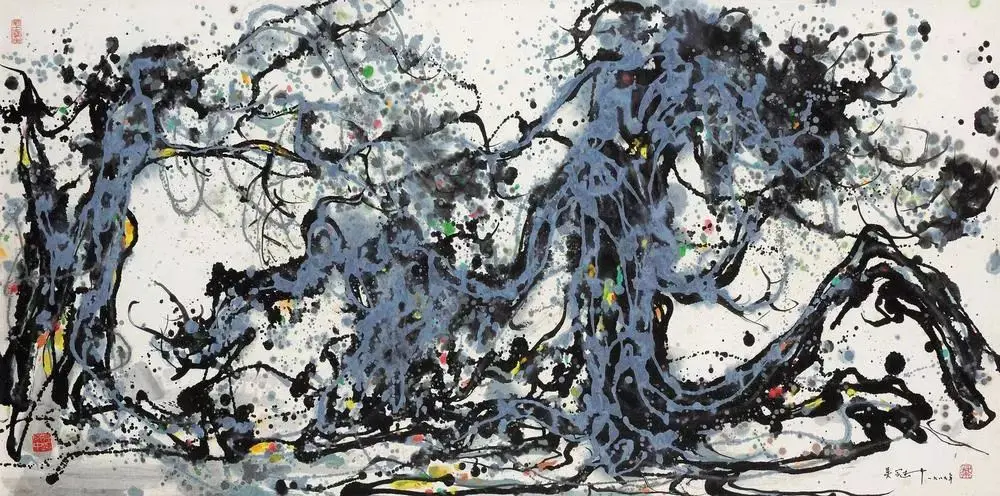
And finally, the seventh painting is by Wu Guangzhong (吳冠中). The title is “Qiu Song,” (虯松) or “Dragon Pine,” or “Pine Tree.” It’s from 1989. Wu Guangzhong was a famous Chinese painter who also studied in France. This painting, again, is very different from what we’ve seen before. While this painting is about trees, it’s not about the actual individual trees or the specifics of the trees. Wu Guangzhong is showing us the life, the dance, the energy, the qi (气) of the trees. How they move, how the energy passes from the tree outwards, along the branches and the leaves. Enveloping them, and going here and there, back and forwards and up and around. Showing us life and the dance and energy.
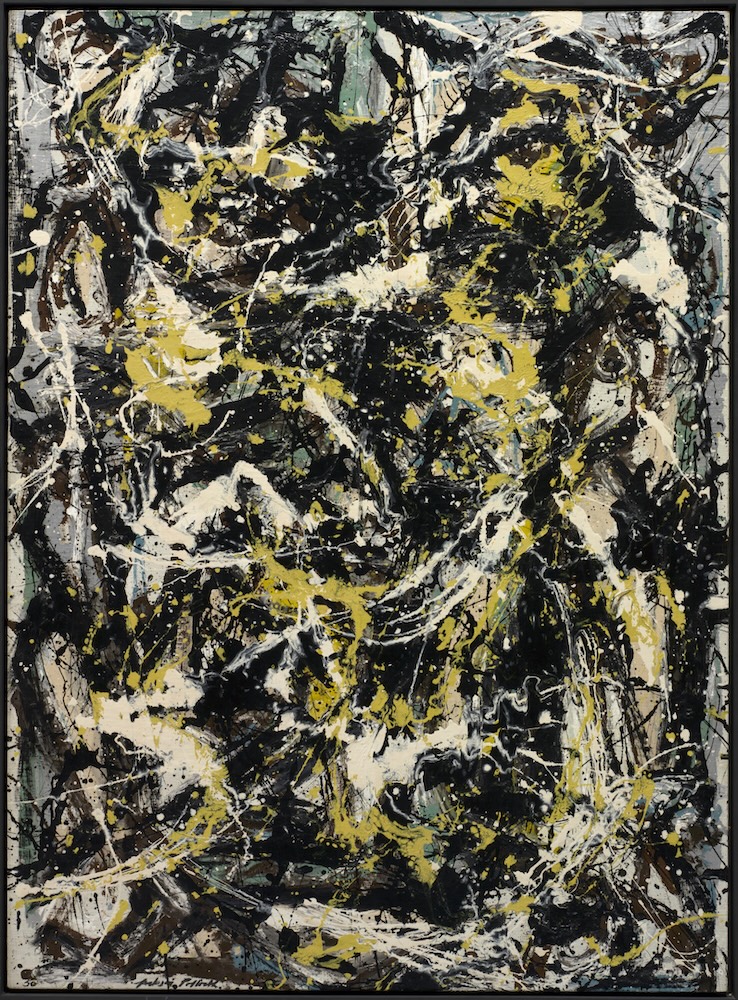
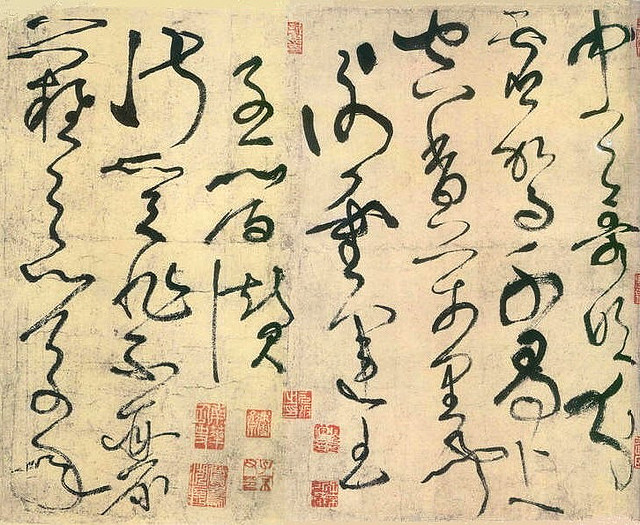
We can see a strong relationship to an artist like Jackson Pollock. At the same time, we also see the clear relationship with Chinese calligraphy that he was so well versed in. This shows through the line, the movement, the energy that he shows us in this painting.
We’ve just looked at a nice array of paintings of trees, and I think it gives us a great place to think about how do we like to paint? And there’s really two topics here. One is, what do we like to look at? When we think about trees, what attracts us? What do we want to talk about? What is the conversation that we want to have? And the other thing is, how do we like to paint? What attracts us to a painting? What attracts us to the scene that we’re seeing as we look at the tree? Is it these fine details, the way the light plays off of it, like we saw earlier with Claude Lorrain? Is it the space around it that we saw with Piet Mondrian? Is it the colors and the way they play in different ways to approach color? Is it light, or is it just color? Is it Van Gogh? Is it Corot? Is it Monet? Or is it the dance and the energy and the life that we see here with Wu Guangzhong?
It can be a lot of these things. It doesn’t have to be just one or the other. But we do have to make choices. We can’t paint like Wu Guangzhong and Claude Lorrain at the same time. We’re going to have to make choices about, what style do we want to use. How do we want to speak. How do we want to talk about what we are seeing, what interests use, what really drives us in this scene?
In addition, we can consider how we like to paint. When you’re sitting in front of the easel, or you’re standing there painting, how do you enjoy painting? What do you like? Some people are very meticulous and they want to focus on small details. They want to take a very small brush and get into each little detail: this leaf and that leaf, and the feeling of this leaf and the feeling of that, and the slight touch of light on this leaf and the shadow. Other people are going to take a bigger brush, bigger swath of color, maybe even a palette knife, put it in paint in a strong, direct manner. There are very different ways of approaching a painting.
When we go to a museum, it really tells us a lot about the artist, and it tells us something about ourselves as well, what attracts us, what are we naturally drawn to. As we understand more about different aspects of a painting, such as seven different ways to paint trees, we can also start to enjoy paintings that we might not originally have been drawn to. When I first looked at Claude Lorrain I could see their excellence, but it took me a little time to really start to appreciate them, to see and feel more deeply what he was doing. For me, it was easier to look at Van Gogh and say, wow, that’s amazing, that’s beautiful. How marvelous. Paintings such as those by Claude Lorrain took more time for me. However, the more I understood it, the more I thought about how he was painting and how he was approaching it, how he was using materials, how he was sitting there and looking at the topics and studying it and approaching it, the more I thought about that from the point of view of how he was painting, the more I was able to understand and enjoy it for myself as a viewer of his paintings in the museum.