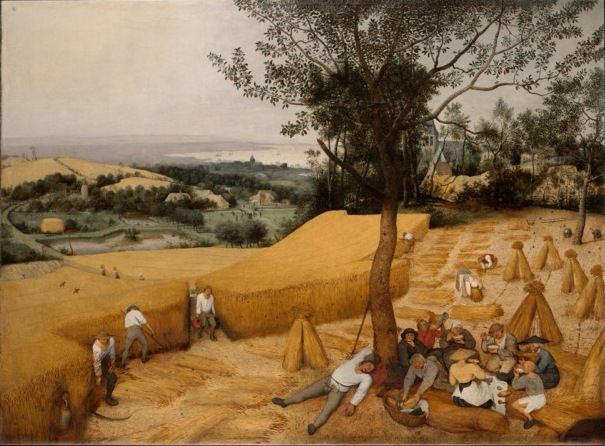
Previously, we looked at Bruegel’s painting, The Harvesters. And in that video, we talked about how Bruegel, he plays with the space. He moves us, he actually moves us around where we’re standing in relation to the space of the painting. So we start by standing on one side of the painting and then we shift. We look at the painting from here and then we look at the painting from over here. He shifts how we’re seeing and how we’re relating to the space of the painting. And this is really fascinating. It’s a wonderful painting. It creates a sense of grandeur, really tells a special story, all of its own through the way that he uses space and color.
But I didn’t want to leave the impression that Bruegel completely invented this idea of shifting our perspective or changing the point of view from which we see things.
Now, I don’t know exactly where this idea started. Certainly, I’ve seen it in a lot of different work. I’ve seen it in very, very early Chinese work. I’ve seen it in work from different cultures in different parts of the world. But I thought it would be interesting to see where might Bruegel have gotten this idea. I’m not saying that he copied it exactly or did the same thing. What I’m thinking is that he saw work that did somewhat similar things. And perhaps he said, hey, this is really wonderful. And I can use this in different ways because we see Bruegel playing with space in different ways.
One place that we can see this idea is in the work of Peter Coecke van Aelst. He was also a Flemish Dutch painter. Some people say that he was Bruegel’s teacher. Some people dispute that. I don’t know. I’m not an art historian, but I can say that van Aelst was active in the same area that Bruegel was just a little bit before Bruegel. So Bruegel was probably at least aware of the work. If he didn’t study with him, at least he was probably aware of it. So we can leave it at that. That Bruegel probably knew about this work.
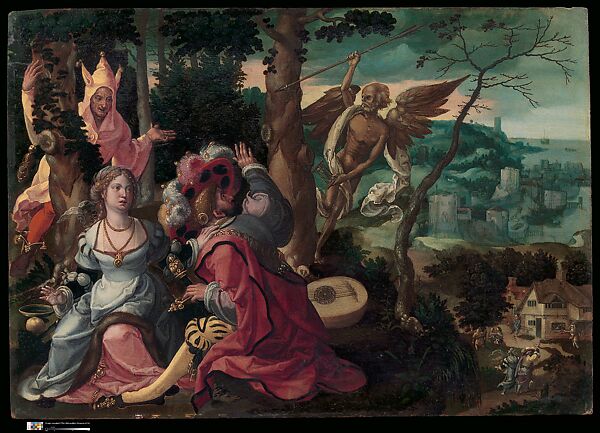
Let’s look at this work here called Lovers Surprised by a Fool and Death. And we can see here in this painting, we have a pair of lovers. We’ve got, I guess, a fool and we have death surprising them, as the title would suggest. And what I find really interesting here is how there’s really, I guess, three main sections of this painting. We have the group of people, the lovers, the fool, we have death, all in one section on the left. And then, at least I tend to go up to the right to this, I guess it’s a village by the sea, and I kind of move back to that space in the background. And then my eye is taken down to the bottom on the right, and I guess it’s another little village, a few houses, and some people approaching that along a trail. I don’t really know the whole story here, so I don’t know fully what’s going on. But what is interesting is we can see how Van Aalst is taking us to different sections in this painting, different spaces, perhaps different times, and he’s moving us through them. And so we can already see from an artist who is in the same region as Bruegel and just a little bit before Bruegel, we can see an instance of this same kind of idea of taking us, moving us through space, shifting our point of view, shifting where we’re standing in relation to the painting. So first I’m over here, I’m standing this way looking at the painting, then I’m over there and I’m looking this way, now I’m looking down over here. So it’s shifting where I am in relation to the painting, which is really fascinating. And so we can see that Bruegel had an example of this right in front of him, right where he was painting and growing up.
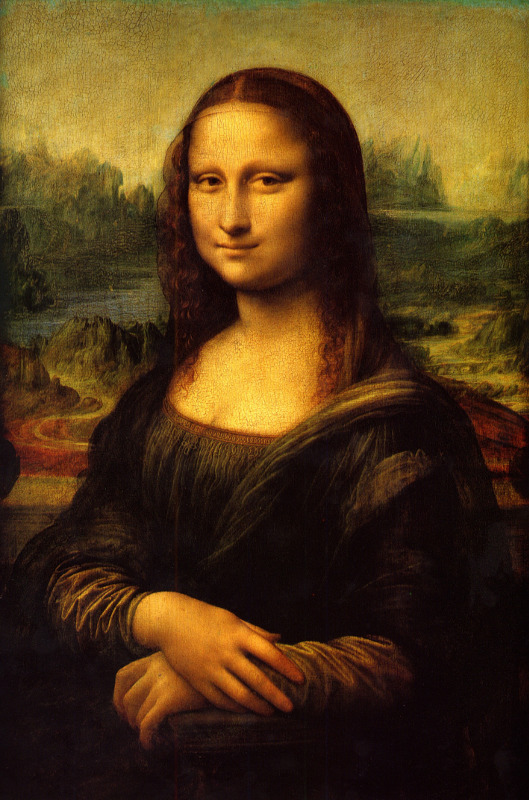
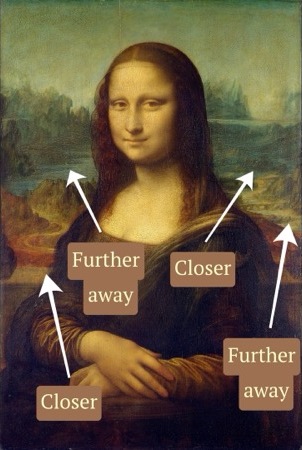
There’s another example. Bruegel also went to Italy and studied. And as an example of an artist who did create two different planes, two different spaces, we can see the Mona Lisa by da Vinci. And behind the Mona Lisa we have one area of the background is moving very close to us, and the other area in the background is further away. I think da Vinci does this to keep us moving around Mona Lisa, keep the space exciting, keep us interesting so we don’t just get fixated on one space and our eye doesn’t really move around. This way we’re shifting and moving throughout the space. But we do know that Bruegel went to Italy and he studied there. And so I would imagine, at least quite likely, that he may have seen the Mona Lisa and was able to study this idea, this use of space.
Artwork
Pieter Coecke van Aelst, Lovers Surprised by a Fool and Death
https://www.metmuseum.org/art/collection/search/239347
Leonardo da Vinci, Mona Lisa
https://en.wikipedia.org/wiki/Mona_Lisa